Chessmen — framed and displayed

Chessmen

U.S. Patent No. 380,820 · 1887

By the late nineteenth century the Staunton chess set — designed in 1849 and named for Howard Staunton — had become the de facto standard for tournament play. A wave of American chess-piece patents in the 1880s codified the silhouettes for industrial production. Schmitthenner's 380,820 is one of the early formal records: six figures, each a piece type, drawn in the spare draughtsman line that has since become the visual grammar of the game.

From $149 View Piece
The Chess Board — framed and displayed

The Chess Board

U.S. Patent No. 1,142,480 · 1915

Cooper's 1915 patent is for a chess board with inlaid contrasting woods — the figure shown is the plan view of the 8×8 grid alongside the section drawing that specifies the board's three laminated layers. The dimensions, the precise contrast between the squares, and the ratio of mat to playing surface trace back through this and a handful of contemporaneous patents that defined how a chess board would look for the next century.

From $149 View Piece
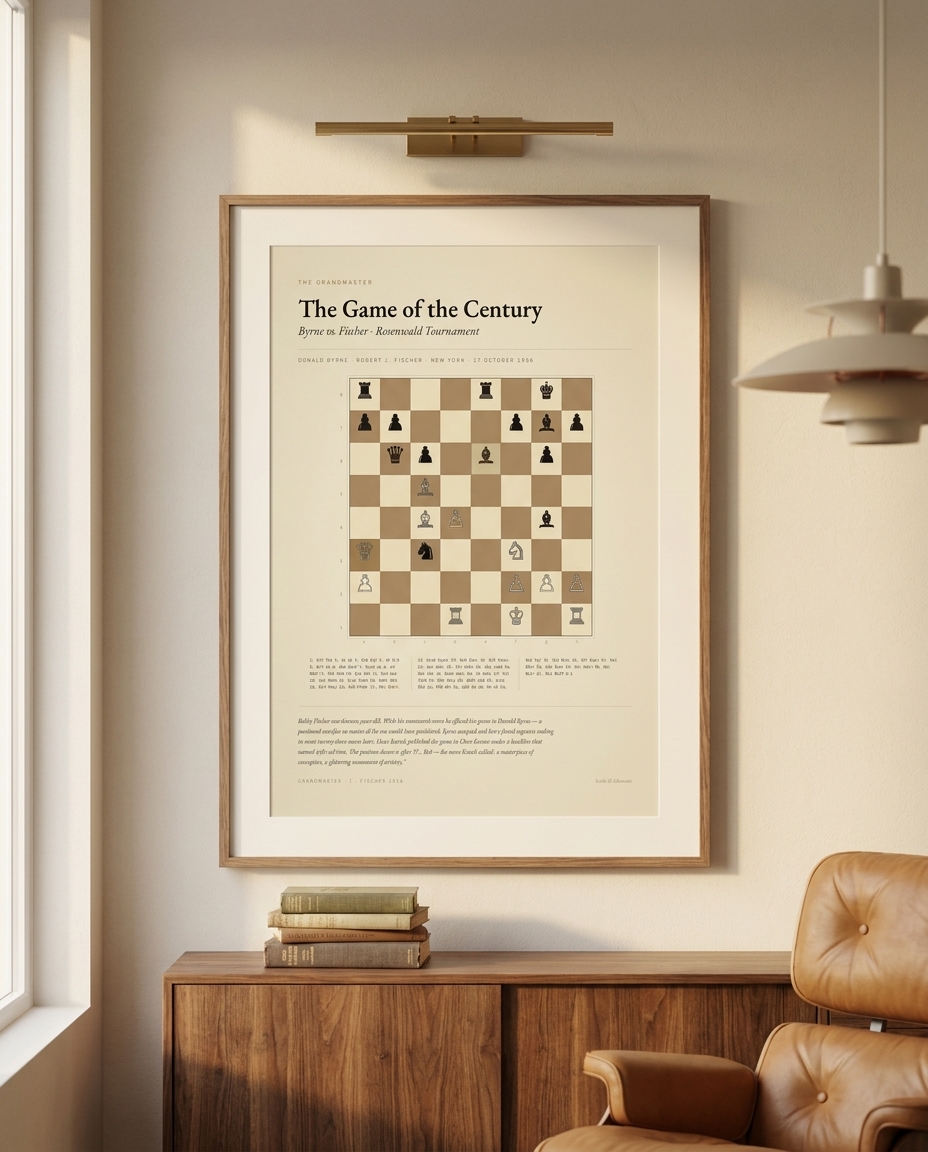
The Game of the Century — framed and displayed

The Game of the Century

Byrne vs. Fischer · 1956

Bobby Fischer was thirteen years old. With his seventeenth move he offered his queen to Donald Byrne — a positional sacrifice no master of the era would have considered. Byrne accepted and lost a forced sequence ending in mate twenty-three moves later. Annotating the game in Chess Review, December 1956, Hans Kmoch called it "a stunning masterpiece of combination play performed by a boy of 13 against a formidable opponent." The headline he gave it — "The Game of the Century" — has stayed.

From $149 View Piece
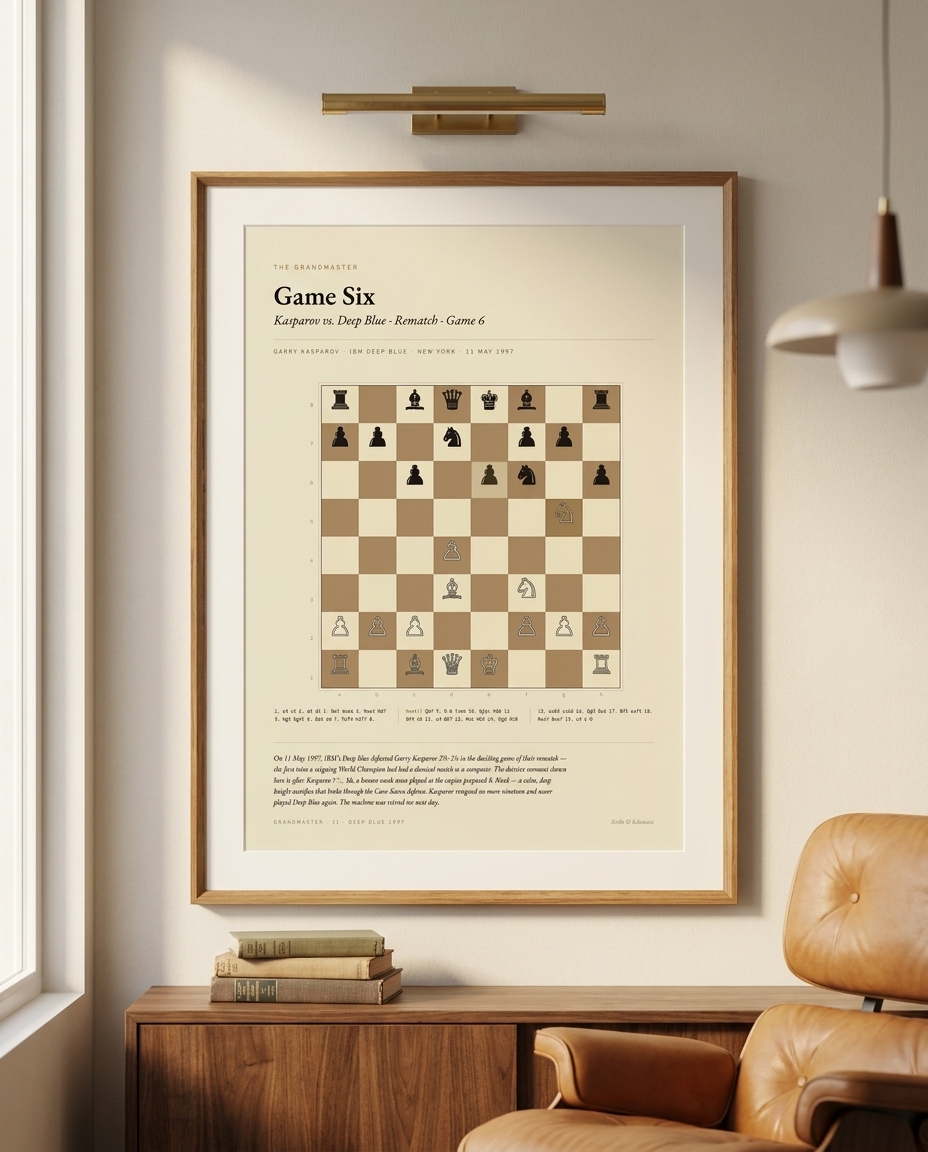
Game Six — framed and displayed

Game Six

Kasparov vs. Deep Blue · 1997

On 11 May 1997, IBM's Deep Blue defeated Garry Kasparov 3½–2½ in the deciding game of their rematch — the first time a reigning World Champion had lost a classical match to a computer. The decisive moment shown here is after Kasparov's 7... h6, a known weak move played as the engine prepared 8. Nxe6 — a calm, deep knight sacrifice that broke through the Caro-Kann defense. Kasparov resigned on move nineteen and never played Deep Blue again. The machine was retired the next day.

From $149 View Piece
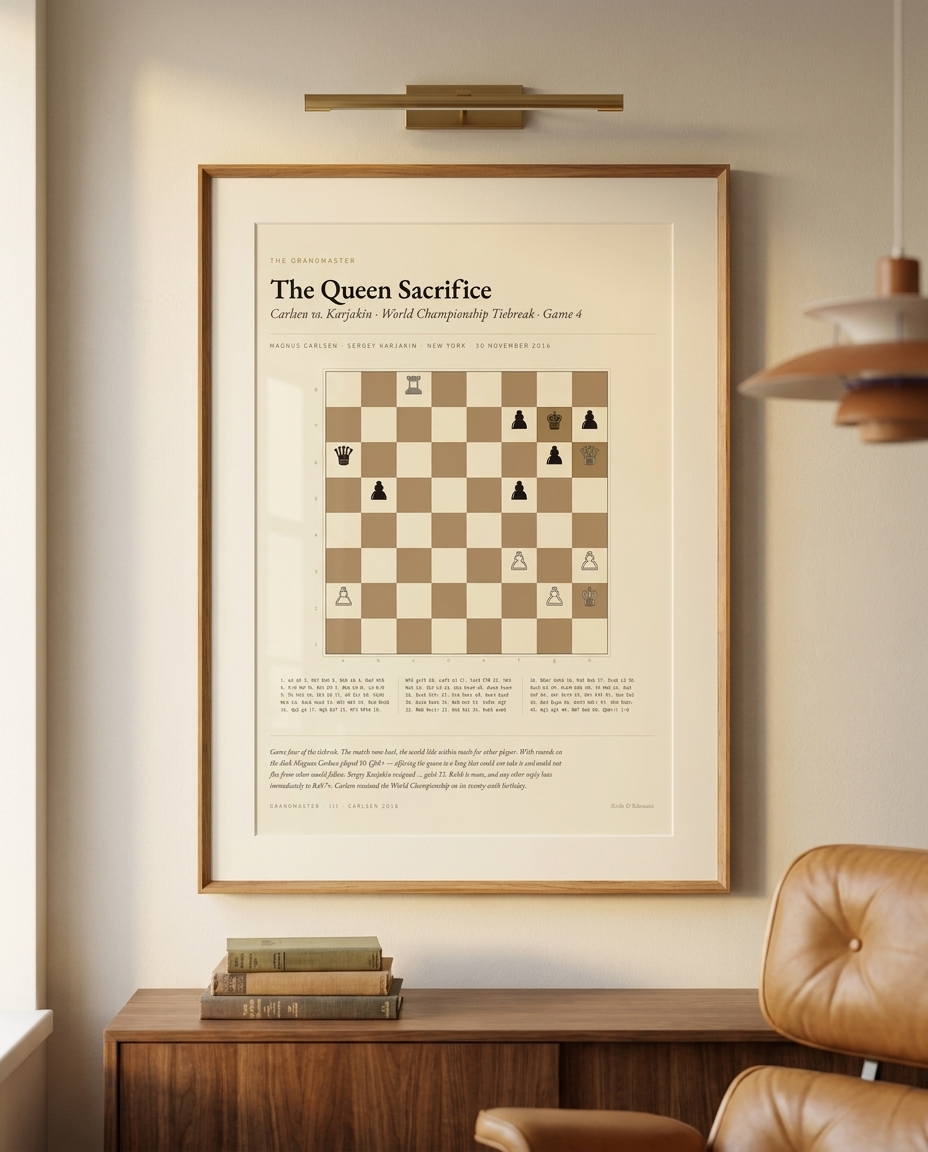
The Queen Sacrifice — framed and displayed

The Queen Sacrifice

Carlsen vs. Karjakin · 2016

Game four of the tiebreak. The match score level, the world title within reach for either player. With seconds on the clock Magnus Carlsen played 50. Qh6+ — offering his queen to a king that could not take it and could not flee from what would follow. Sergey Karjakin resigned: ... gxh6 51. Rxh6 is mate, and any other reply loses immediately to Rxh7+. Carlsen retained the World Championship on his twenty-sixth birthday.

From $149 View Piece