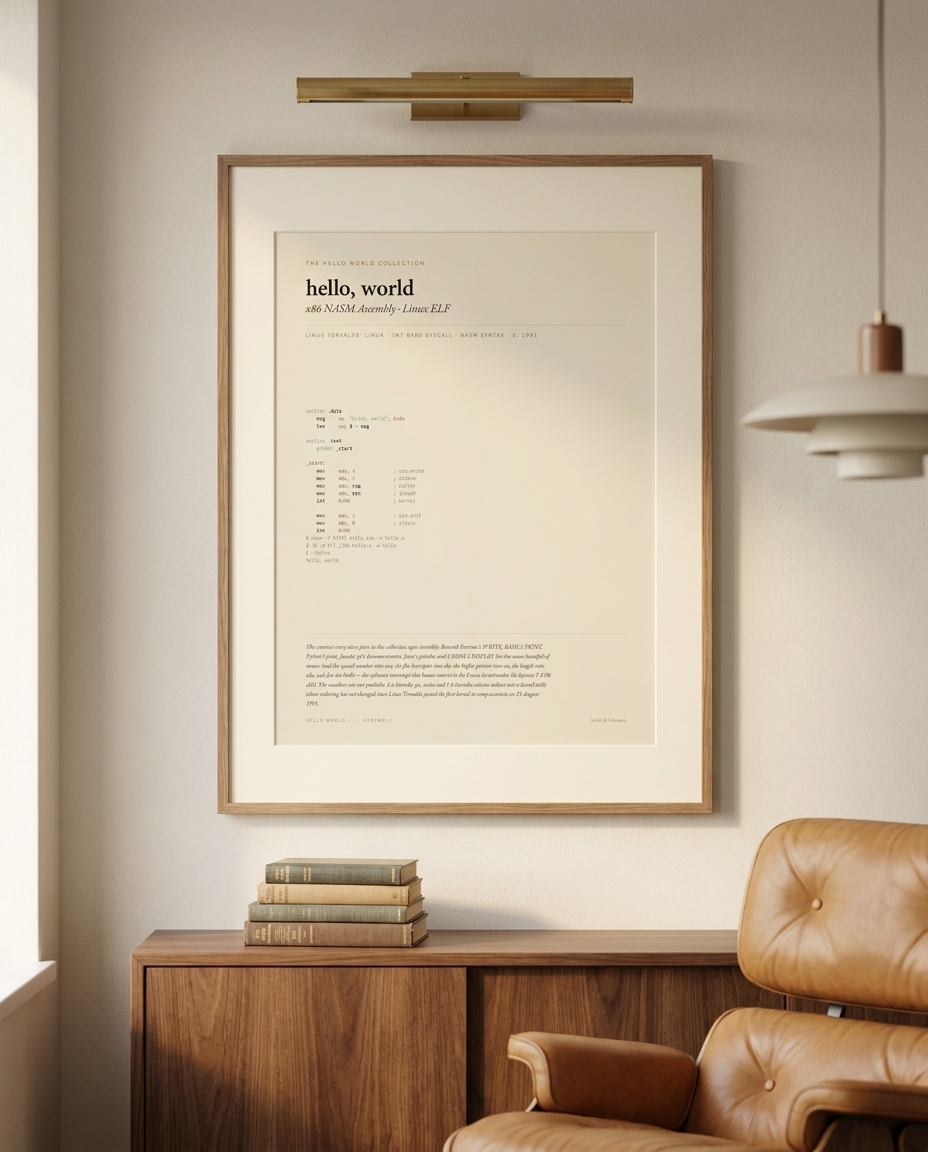
The Substrate — Assembly — framed and displayed

The Substrate — Assembly

x86 NASM · Linux ELF

The contract every other piece in this collection signs invisibly. Beneath Fortran's WRITE, BASIC's PRINT, Python's print, JavaScript's document.write, Java's println, and COBOL's DISPLAY lies this same handful of moves: load the syscall number into eax, the file descriptor into ebx, fire int 0x80. The numbers are not symbolic — 4 is literally sys_write and 1 is literally stdout, indices into a kernel table whose ordering has not changed since Linus Torvalds posted the first kernel to comp.os.minix on 25 August 1991.

From $149 View Piece
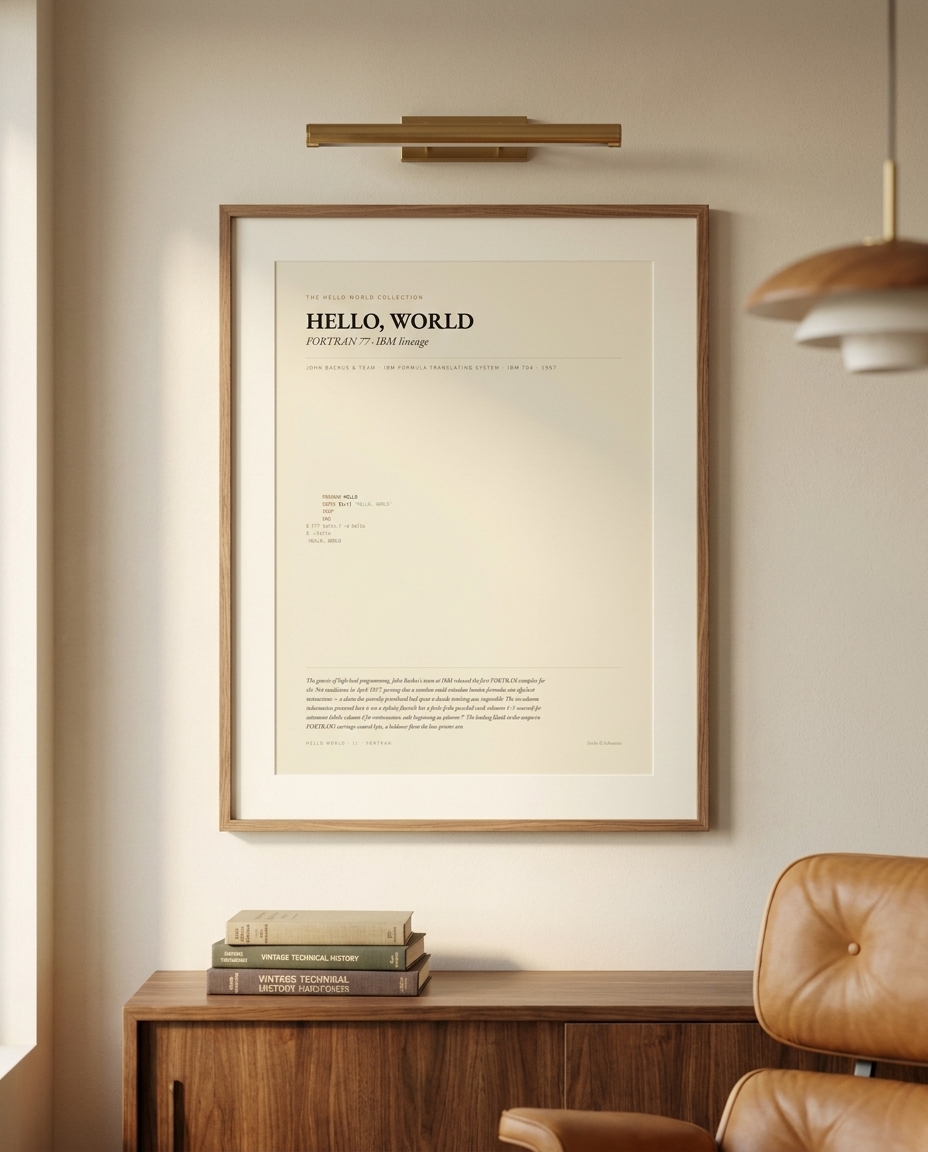
The Genesis — Fortran — framed and displayed

The Genesis — Fortran

FORTRAN 77 · IBM lineage

The genesis of high-level programming. John Backus's team at IBM released the first FORTRAN compiler for the 704 mainframe in April 1957, proving that a machine could translate human formulas into efficient instructions — a claim the assembly priesthood had spent a decade insisting was impossible. The six-column indentation preserved here is a fossil of the punched card: columns 1–5 reserved for statement labels, column 6 for continuation, code beginning at column 7.

From $149 View Piece
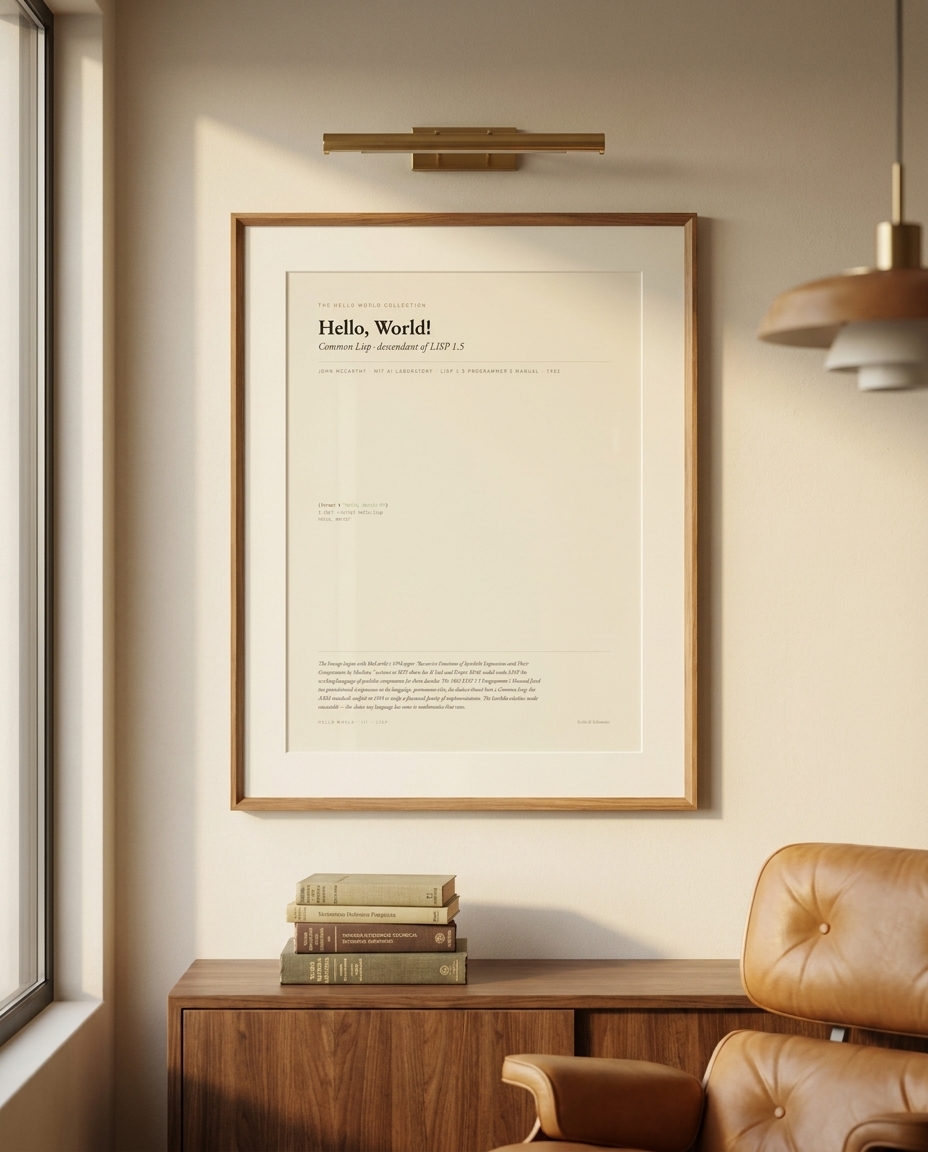
The Mind — LISP — framed and displayed

The Mind — LISP

Common Lisp · descendant of LISP 1.5

The lineage begins with McCarthy's 1958 paper "Recursive Functions of Symbolic Expressions and Their Computation by Machine," written at MIT where the AI Lab and Project MAC would make LISP the working language of symbolic computation for three decades. The 1962 LISP 1.5 Programmer's Manual fixed the parenthesized S-expression as the language's permanent skin; the dialect shown is Common Lisp, the ANSI standard ratified in 1994.

From $149 View Piece
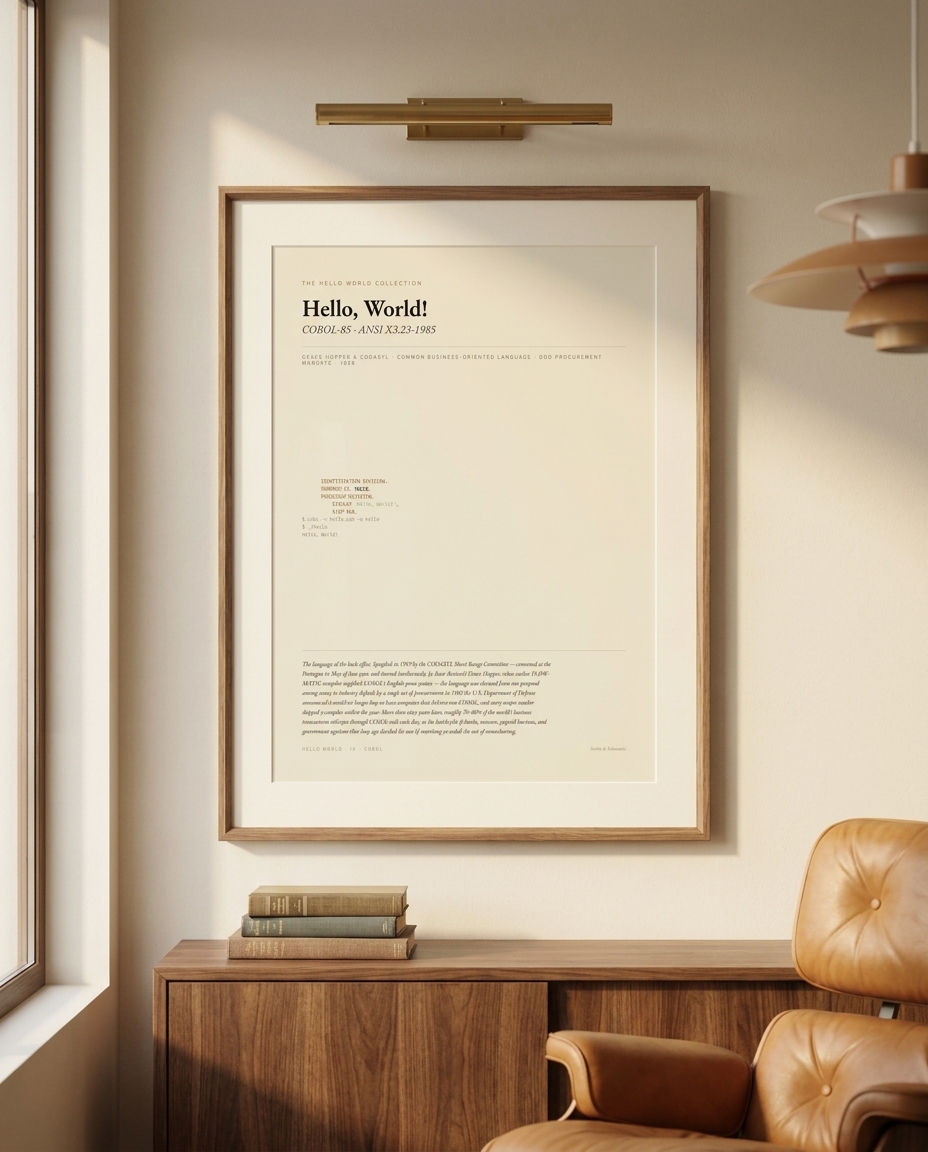
The Bureau — COBOL — framed and displayed

The Bureau — COBOL

COBOL-85 · ANSI X3.23-1985

Specified in 1959 by the CODASYL Short Range Committee — steered intellectually by Rear Admiral Grace Hopper, whose earlier FLOW-MATIC compiler supplied COBOL's English-prose syntax — the language was elevated to industry default by a single act of procurement: in 1960 the U.S. Department of Defense announced it would no longer buy or lease computers that did not run COBOL. More than sixty years later, roughly 70–80% of the world's business transactions still pass through COBOL code each day.

From $149 View Piece
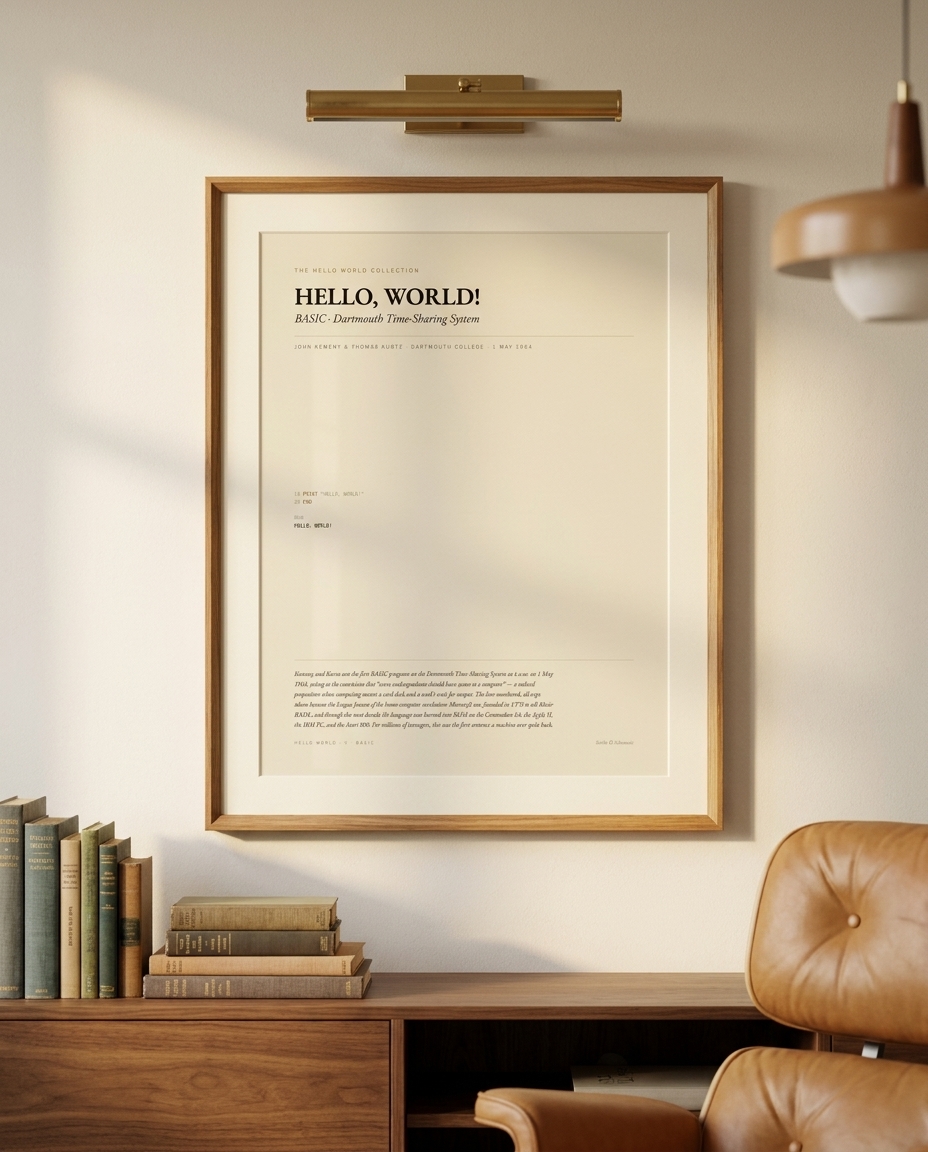
The Democracy — BASIC — framed and displayed

The Democracy — BASIC

BASIC · Dartmouth Time-Sharing System

Kemeny and Kurtz ran the first BASIC program on the Dartmouth Time-Sharing System at 4 a.m. on 1 May 1964, acting on the conviction that "every undergraduate should have access to a computer." The line-numbered, all-caps idiom became the lingua franca of the home-computer revolution: Microsoft was founded in 1975 to sell Altair BASIC, and through the next decade the language was burned into ROM on the Commodore 64, the Apple II, the IBM PC, and the Atari 800.

From $149 View Piece
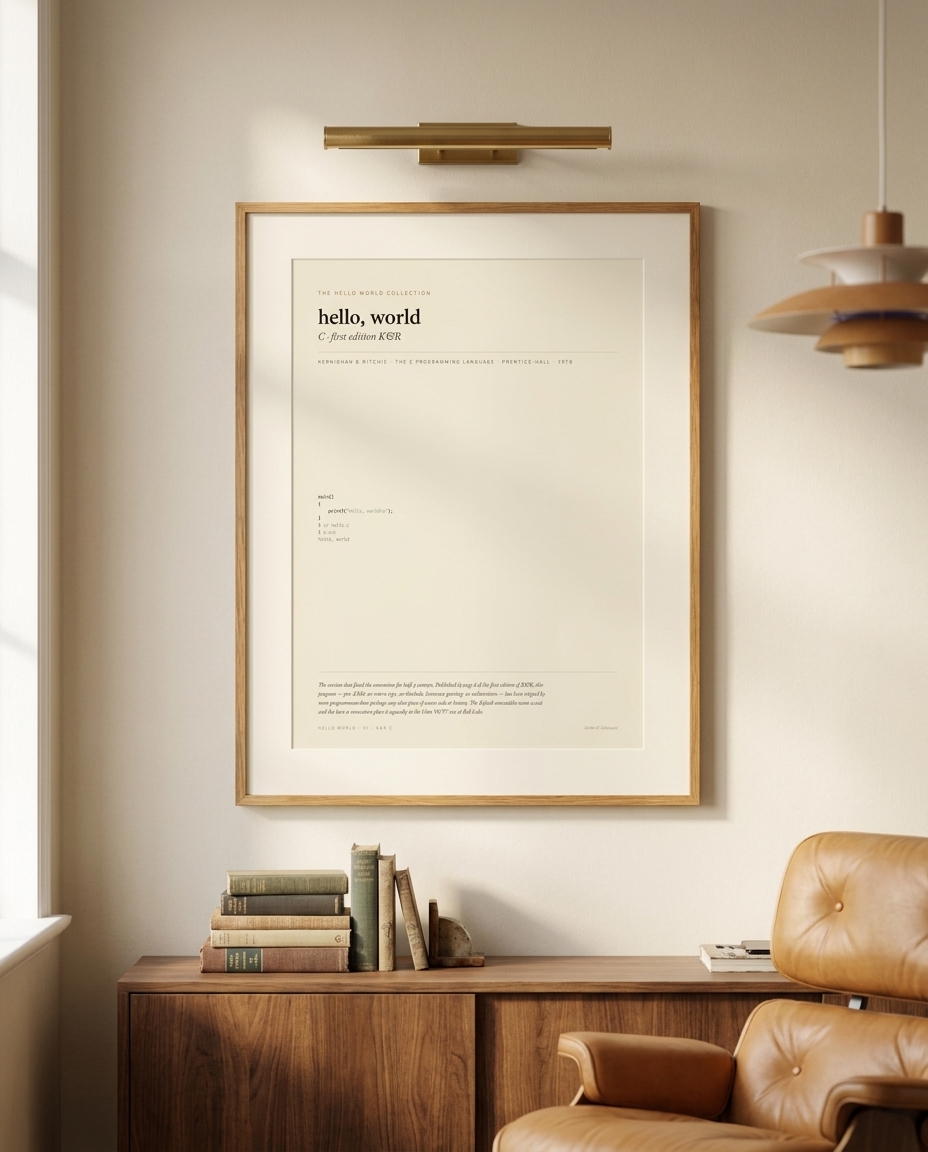
The Canon — K&R C — framed and displayed

The Canon — K&R C

C · first edition K&R

The version that fixed the convention for half a century. Published on page 6 of the first edition of K&R, this program — pre-ANSI, no return type, no #include, lowercase greeting, no exclamation — has been retyped by more programmers than perhaps any other piece of source code in history. The default executable name a.out and the bare cc invocation place it squarely in the Unix V6/V7 era at Bell Labs.

From $149 View Piece
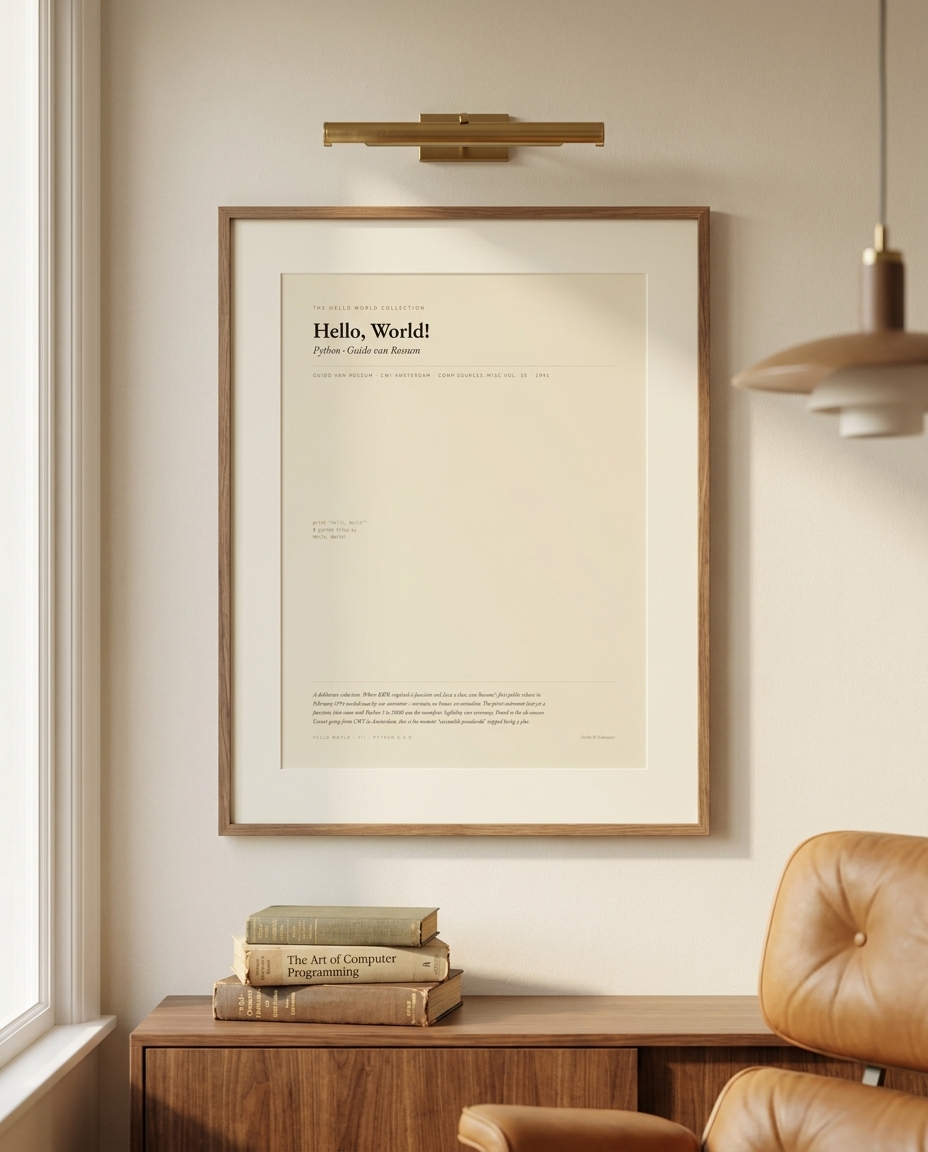
The Discipline — Python — framed and displayed

The Discipline — Python

Python · Guido van Rossum

A deliberate reduction. Where K&R required a function and Java a class, van Rossum's first public release in February 1991 needed exactly one statement — no main, no braces, no semicolon. The print statement (not yet a function; that came with Python 3 in 2008) was the manifesto: legibility over ceremony. Posted to the alt.sources Usenet group from CWI in Amsterdam.

From $149 View Piece
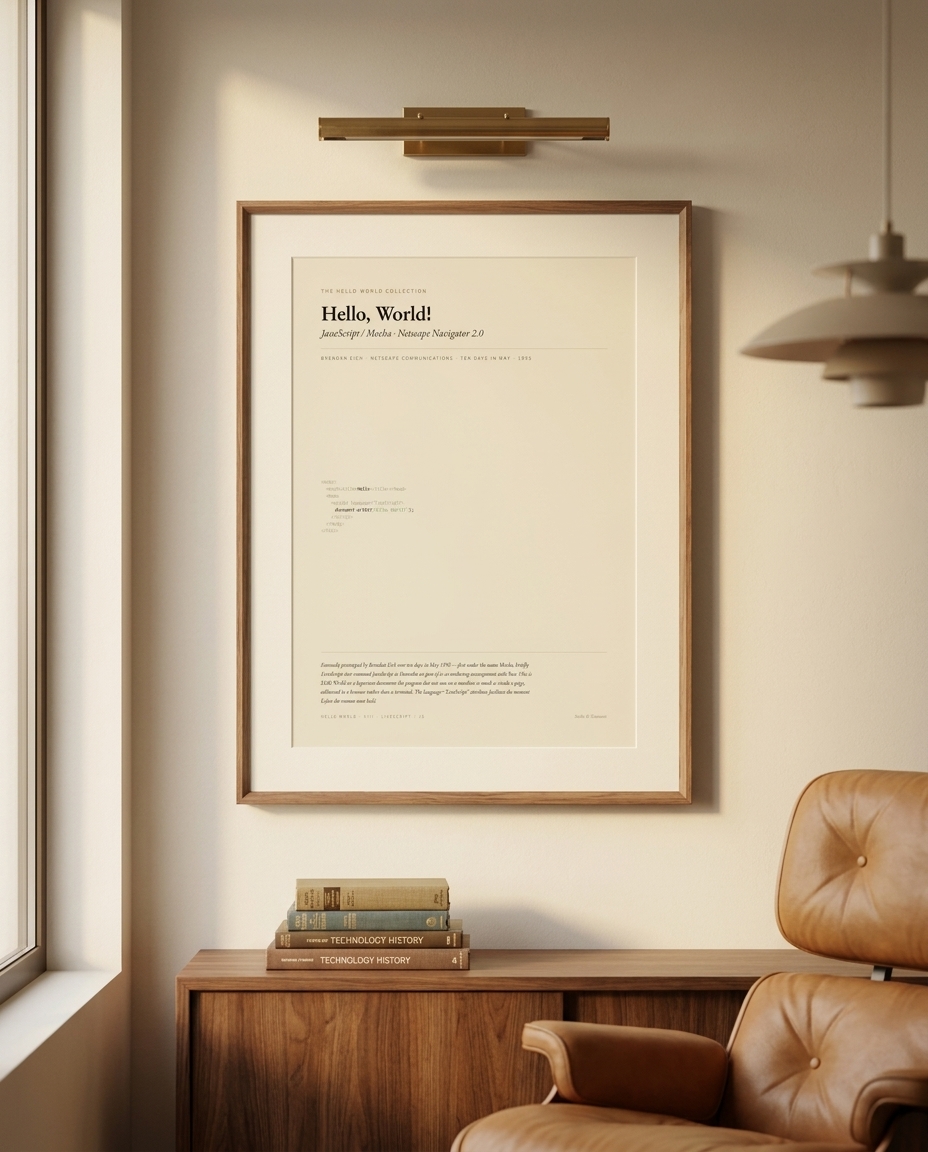
The Web — JavaScript — framed and displayed

The Web — JavaScript

JavaScript / Mocha · Netscape 2.0

Famously prototyped by Brendan Eich over ten days in May 1995 — first under the name Mocha, briefly LiveScript, then renamed JavaScript in December as part of a co-marketing arrangement with Sun. This is Hello World as a hypertext document: the program does not run on a machine so much as inside a page, addressed to a browser rather than a terminal. The language="LiveScript" attribute fossilizes the moment before the rename took hold.

From $149 View Piece
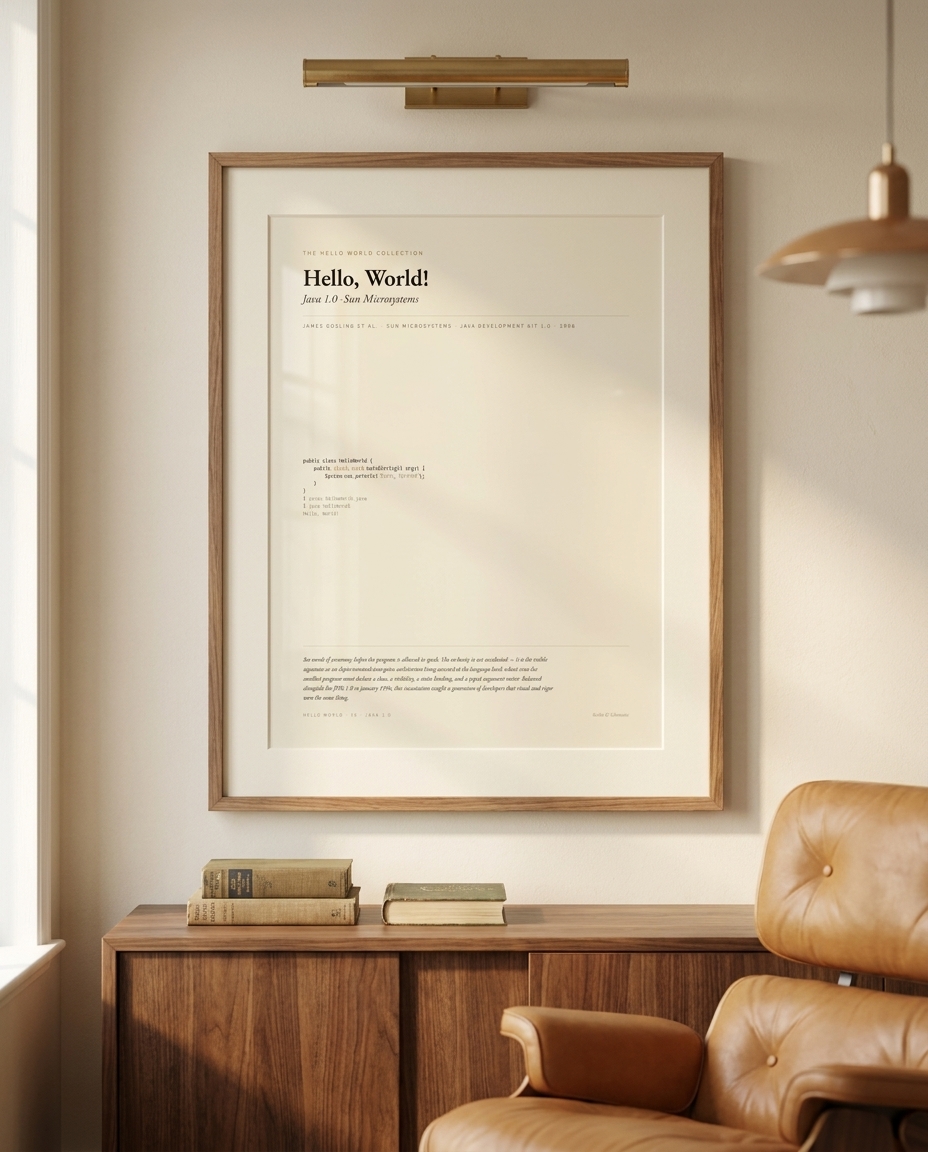
The Bureaucracy — Java — framed and displayed

The Bureaucracy — Java

Java 1.0 · Sun Microsystems

Six words of ceremony before the program is allowed to speak. The verbosity is not accidental — it is the visible signature of an object-oriented enterprise architecture being asserted at the language level, where even the smallest program must declare a class, a visibility, a static binding, and a typed argument vector. Released alongside the JDK 1.0 in January 1996, this incantation taught a generation of developers that ritual and rigor were the same thing.

From $149 View Piece